mmHg Compression Levels Explained: How US Classes Map to EU RAL-GZ 387 (Buyer's Guide)
- US: mmHg bands 8–15, 15–20, 20–30, 30–40. EU: RAL-GZ 387 classes CCL1–CCL4, defined by ankle pressure at measurement point B.
- The systems overlap but do not convert: 15–20 ≈ CCL1, 20–30 ≈ CCL2, 30–40 ≈ CCL3. Label each SKU to its target market's standard.
- RAL-GZ 387 adds a durability gate most US catalogs ignore: no more than 15% pressure loss within three months of normal wear.
- US medical positioning runs on FDA 510(k) (Class II, 21 CFR 880.5780, code DWL); the EU generally takes MDR Class I self-declaration. Put evidence in the PO: HOSYcan full-length profiles or MST point readings (B/B1/C/D), per batch, with after-wash decay data.
Buy compression socks for a US storefront and the spec sheet may still say CCL2 — and nothing tells your customer, or a compliance reviewer, which standard applies. Both systems measure ankle pressure in mmHg but slice, test and regulate it differently. This guide maps the overlap and turns the differences into a checklist for labels, inserts and test reports.
Why compression classes matter for B2B buyers
For a brand or marketplace seller, the compression class moves three numbers in your P&L.
Returns. Compression is one of the few categories where a wrong grade is physically felt. Buy 20–30 mmHg expecting everyday comfort and it feels clinical; need real graduated pressure and receive fashion-grade fabric, and the reviews say "no effect". Clear labeling filters the mismatch before checkout.
Compliance. Position a US listing as medical — in practice 20–30 mmHg and above with therapeutic wording — and FDA treats it as a Class II device (21 CFR 880.5780, code DWL) requiring 510(k) clearance, while the EU generally takes MDR Class I self-declaration. A misgraded label quietly moves a product between regimes.
Repeat purchase. Compression wears out. The benchmark is written into RAL-GZ 387: no more than 15% pressure loss within three months of normal wear. Products that hold pressure produce replenishment orders; products that sag produce returns.
The weight is real: medical compression stockings took 41.8% of the 2024 global market, and the 30–40 mmHg class alone 46.5% of revenue (Mordor Intelligence, 2025).
The US system: four OTC mmHg bands
The US convention — used across pharmacies, medical supply and e-commerce — grades by the ankle pressure range printed on the pack. Four bands cover the whole retail assortment. It is an industry convention, not a government scheme — so self-declared numbers need test reports behind them.
| Band | Level | Common positioning | Suitable for |
|---|---|---|---|
| 8–15 mmHg | Mild | "Light relief" lines; diabetic-friendly and sensitive-leg designs | Everyday wearers new to compression; wide-cuff socks for sensitive legs, on professional advice |
| 15–20 mmHg | Light | The default e-commerce band | People who stand or sit for long shifts, frequent flyers, pregnancy-related tired legs, sports recovery |
| 20–30 mmHg | Moderate | The medical-grade threshold; the most-prescribed tier | Moderate swelling, varicose veins, chronic venous insufficiency, post-procedure recovery and DVT-prevention contexts, under medical guidance |
| 30–40 mmHg | Firm | Prescription tier | Severe venous insufficiency, post-thrombotic syndrome, venous ulcers and lymphedema management, under physician supervision |
Table 1 — US mmHg bands and typical positioning (industry-common OTC convention).
Two practical reads: 15–20 mmHg is where most marketplace listings live. Once a listing crosses into 20–30 mmHg with medical wording, the FDA device rules above apply.
The EU system: RAL-GZ 387 and classes CCL1–CCL4
Europe's reference is RAL-GZ 387/1 (2018), the German quality standard for medical circular-knit compression stockings behind the blue RAL mark; institutes such as Hohenstein test it against DIN 58133. Where the US works with loose trade bands, RAL defines four classes by ankle compression range at point B:
| Class | Ankle pressure (point B) | Typical positioning — suitable for |
|---|---|---|
| CCL1 | 18–21 mmHg | Light daily support for tired, heavy legs; long shifts and travel |
| CCL2 | 23–32 mmHg | The workhorse medical class: varicose veins, moderate swelling, post-procedure care under medical guidance |
| CCL3 | 34–46 mmHg | Severe venous conditions and ulcer management, prescribed and fitted |
| CCL4 | ≥49 mmHg | Specialist-grade compression, mainly hospital and clinic channels |
Table 2 — RAL-GZ 387 compression classes (ankle pressure at measurement point B).
RAL also fixes the shape of the pressure: the gradient must run from 100% at the ankle to roughly 70% at the calf and 40% at the thigh. It adds a durability gate with no US equivalent — pressure loss of no more than 15% within three months of normal wear. Under MDR 2017/745, medical compression stockings are generally Class I devices with self-declaration.
Mapping US classes to CCL levels: overlap, not conversion
Side by side, the bands roughly correspond — roughly being the operative word:
| US band | Closest RAL class | Ankle-range overlap | Practical note |
|---|---|---|---|
| 15–20 mmHg | CCL1 | 15–20 vs 18–21 mmHg — partial | CCL1 starts higher; 15 mmHg under-shoots the RAL floor |
| 20–30 mmHg | CCL2 | 20–30 vs 23–32 mmHg — partial | A 20–25 mmHg product sits below the CCL2 floor |
| 30–40 mmHg | CCL3 | 30–40 vs 34–46 mmHg — partial | US 40 ceiling sits inside the CCL3 span |
Table 3 — Indicative mapping only. Not a conversion table.
Different systems, not directly convertible. A label reading "20–30 mmHg = CCL2" without test data behind the named standard is not a translation — it is a compliance exposure. Pick the market convention per SKU, test against it, print it.
Settling it early — which standard does this SKU speak — resolves most downstream disputes: the pack number, the report behind it, the regulatory path. The same comparison in production-order terms is shown in our dual-system compression class table.
Sourcing playbook: labels, IFUs and test reports
Labels and instructions for use
A compliant label states three things: the band (e.g. 20–30 mmHg), the standard the product was tested to (RAL-GZ 387 CCL2, or "US OTC convention 20–30 mmHg"), and the measurement basis. The IFU adds sizing by ankle and calf circumference, wear schedule, washing and intended population. Keep therapeutic verbs out of both: not "treats varicose veins" but "suitable for tired, heavy legs" — and at 20–30 mmHg or above, "use under medical guidance".
What to demand from test reports
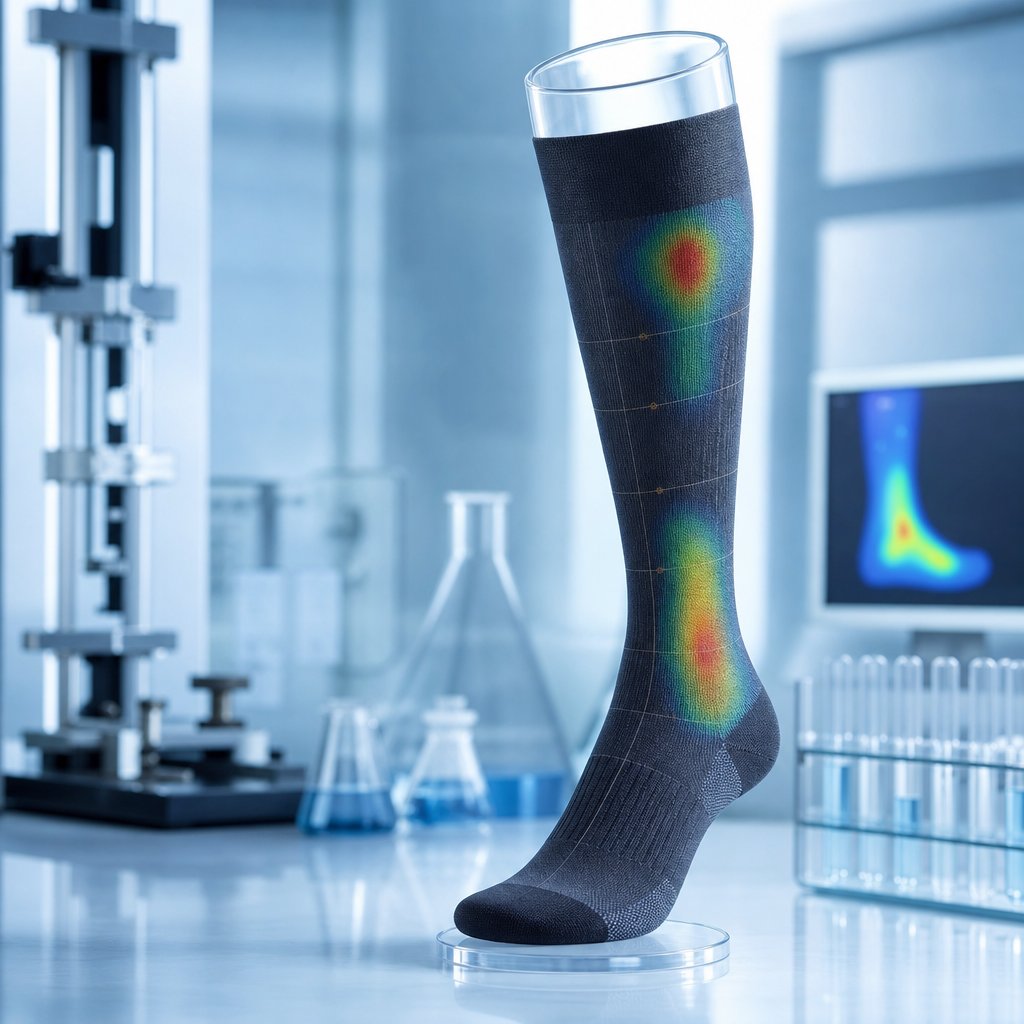
- Full-length profile. HOSYcan-type testing per RAL-GZ 387 / DIN 58133 records pressure along the whole leg — the gradient, not just the ankle number.
- Point checks. MST-type leg forms read B at the ankle, B1 and C at the calf, D at the thigh — fast enough for lot control.
- Per-batch issue. A golden-sample certificate from a previous season says nothing about the shipment in your container.
- Aging data. Pressure after repeated wash and wear cycles, against the RAL limit of 15% loss at three months.
E-commerce listing wording
Listing copy should live on the "suitable for" frame — suitable for long flights, for pregnancy-related tired legs. Reserve medical claims for SKUs that actually hold 510(k) documentation (US) or an MDR technical file (EU). If you fulfill across regions through a dropship model, make the standard a per-destination attribute of the listing — one shared pool feeding several countries is how mixed labels happen. Build the assortment by pressure band: everyday 15–20 mmHg first, then a documented 20–30 mmHg line; our catalog is organized exactly this way.
Three pitfalls that cost buyers real money
1 — Mixed-grade labeling. A factory runs CCL2-spec goods into a US order and prints "20–30 mmHg" without re-testing. Ankle numbers are close enough that nothing fails immediately — until a returns spike or a marketplace compliance request asks which standard the claim refers to. Fix: the PO names standard, class and test method; the label repeats them verbatim.
2 — Testing only the ankle. A sock can read 22 mmHg at the ankle and fall nearly flat by mid-calf. The ankle figure passes; the gradient — the part that does the work — does not exist. Fix: require a full-length profile, or at minimum multi-point readings at B/B1/C/D, for every new pattern.
3 — Skipping wash-decay testing. Out of the box the socks hit spec; after ten home washes the spandex has relaxed and compression sags. Reviews say "lost elasticity within a month", and the replenishment cycle dies with them. Fix: write after-wash pressure data into the QC agreement, against the RAL limit of 15% loss at three months.
Frequently asked questions
Can one SKU carry both a US mmHg band and a CCL class on the label?
Yes — side by side, each tied to its named standard, and only if tested to both. What fails audits is equating them ("20–30 mmHg = CCL2") or converting one number into the other. Print both values, cite both standards, keep a report for each.
Which compression level should a new US e-commerce brand launch first?
Most sellers start at 15–20 mmHg for everyday, athletic and travel buyers, then add 20–30 mmHg as a documented, medical-positioned line. The 30–40 mmHg tier is the largest revenue segment globally but is prescription-driven, demanding the strongest compliance file — better left to established medical channels.
What test reports should I require before placing an order?
For EU-bound goods: a RAL-GZ 387 / DIN 58133 full-length profile (HOSYcan-type) plus after-wash decay data. For US-bound goods: ankle-band verification, ideally MST-type point readings at B/B1/C/D — plus 510(k) documentation if the listing makes medical claims. All reports per batch, not golden-sample only.
Is 20–30 mmHg the same as CCL2?
Approximately, not legally. The bands overlap (20–30 vs 23–32 mmHg at the ankle), and CCL2 adds gradient and durability requirements. Sell under the target market's convention, test against that standard, and label accordingly.