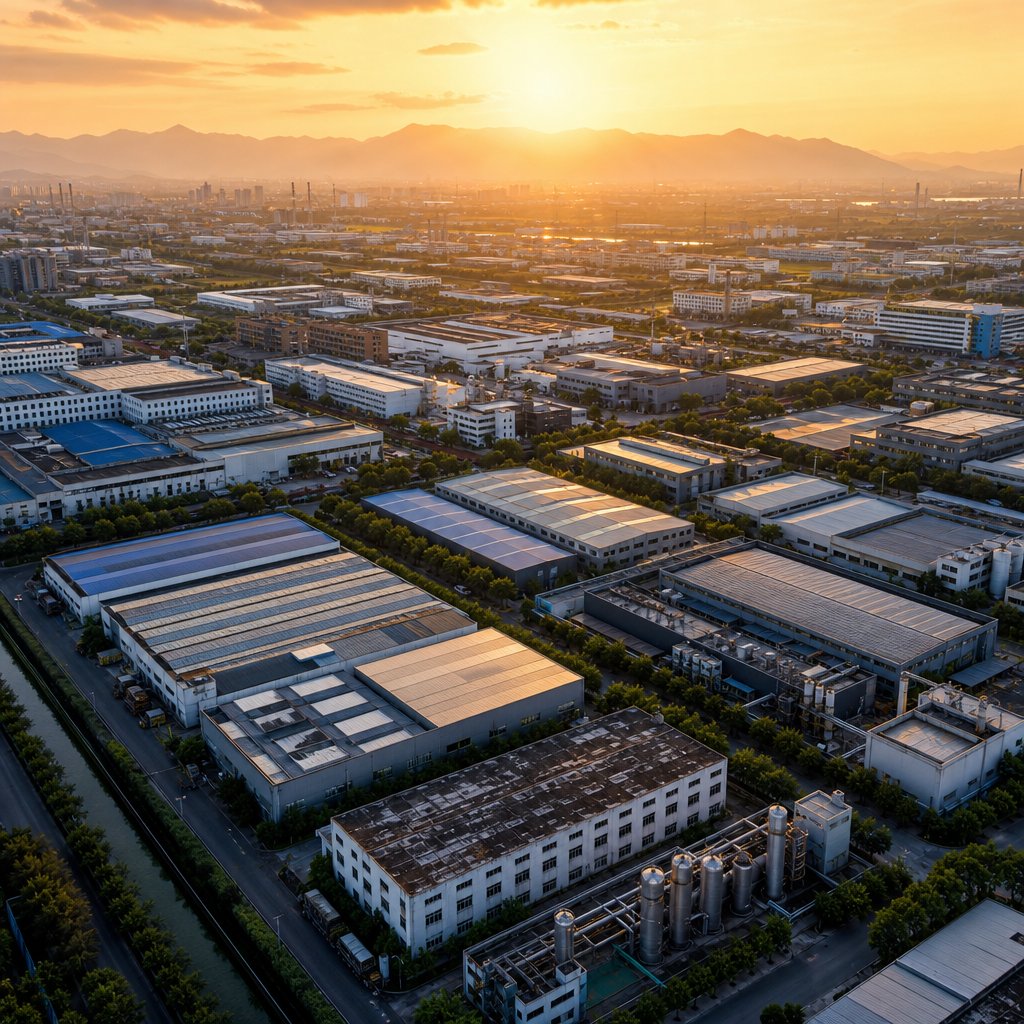
When buyers compare sock suppliers, they tend to compare factories: machine counts, certifications, quotations. What they should compare first is geography — because in hosiery, the factory is only the center of a web, and the web decides how fast you can move.
A sock is a simple product with a long chain behind it: covered yarn (nylon wrapped around spandex), needles and machine parts, dyeing and finishing, boarding and pressing, pressure testing, packaging and labels. No single factory owns all of it. In a mature industrial belt, every link sits within a short drive, and specialist workshops compete for each step of the chain.
That density converts directly into response speed. A sampling revision that requires a different yarn can be resolved the same afternoon: pick it up in the raw-material market, knit overnight, press and test the next day. An isolated factory plans the same revision around days of waiting and freight.
Density is also insurance. If one dye house is fully booked in peak season, another is twenty minutes away. If a machine part fails, a spare is local. This is why industrial belts — not individual factories — are the real unit of competition in Chinese hosiery, and why choosing between belts deserves as much attention as choosing between suppliers. Our own factory and belt setup is built on exactly this logic.
Datang is a town inside Zhuji, Zhejiang province, widely recognized as the world's sock capital. The scale is documented and worth stating with its source: Xinhua-reported figures put the Zhuji hosiery cluster at more than 25 billion pairs a year — roughly one in every three pairs of socks made worldwide — produced by over 10,000 hosiery-related enterprises, with annual cluster output value above RMB 70 billion. Two caveats belong right next to those numbers: they describe the whole regional cluster, not any single company's capacity; and "one in three pairs worldwide" is the cluster's share, not ours.
The structural advantage behind the headlines is the supply chain underneath. The Datang light-industry textile market alone holds 800+ raw-material shops covering nylon, polyester, spandex, covered yarn, rubber thread and cotton. Around it sit machine-parts suppliers, dyeing and finishing houses, toe-closing and boarding workshops, testing services and freight forwarders — most within a thirty-minute loop of the knitting floors.
In practice, three kinds of work belong in Datang:
What Datang is not: the cheapest place to run 100,000 pairs of a proven basic. Coastal labor costs and dense order books mean peak-season queues are real. Paying Datang prices for commodity volume is a classic first-time-buyer mistake.
Anyang, in Henan province, sits in what Chinese industry calls the Central Plains production area: an inland belt built on structurally lower labor and factory-space costs, with textiles and knitwear among its pillar industries. For sock programs, its role is direct — bulk capacity for proven designs, commodity and mid-calf volume, and, in our case, warehousing for cross-border dropship fulfillment.
Here we owe you an honest caveat: public, sock-specific data for Anyang is scarce — treat belt claims with care. What is verifiable describes the wider textile and garment sector, not socks alone; public reporting around 2021 credits Anyang with a textile-and-apparel base of roughly 4,000 enterprises and knitwear revenue above RMB 20 billion. Anyone quoting precise "Anyang sock output" statistics without attribution should raise an eyebrow, not close a deal.
The practical strengths are qualitative but consistent: lower wage levels and rents than coastal Zhejiang, an experienced labor pool for commodity knitting, and capacity that stays available exactly when coastal belts are congested. The trade-offs mirror the advantages: fewer fine-gauge medical lines, thinner local raw-material markets (specialized yarns usually still route through Zhejiang), and less depth in pressure testing and export documentation.
None of this makes Anyang a lesser belt. It makes it a different tool. Buyers who treat Anyang as "cheap Datang" get burned; buyers who use it for what it is — cost-stable bulk capacity under an audited quality system — gain a genuine second engine.
The table below compresses this field note into the five dimensions buyers actually ask about. Note the second row deliberately carries no number: where public data does not exist, saying so is worth more than inventing a figure — and it should push you toward on-site verification, not away from it.
| Dimension | Datang (Zhuji, Zhejiang) | Anyang (Henan) |
|---|---|---|
| Positioning | World hosiery center: R&D, medical-grade, premium and quick response | Central Plains cost belt: bulk capacity and dropship warehousing |
| Scale data availability | Strong public data (Xinhua-reported cluster figures) | Sock-specific public data scarce; only wider textile/apparel figures (circa 2021) |
| Best-fit orders | New patterns, compression/medical grades, small-lot customization, sampling | Proven-SKU replenishment, commodity basics, large volume runs |
| Cost structure | Higher floor — you pay for density, skill and speed | Structurally lower labor and space costs (qualitative) |
| Lead-time behavior | Sampling in 5–7 days; queues in peak season | Stock dispatch within 24h; deep capacity for large runs |
Cluster figures for Datang: Xinhua-reported (2023–2026 coverage). Anyang figures: public reporting on the wider textile and garment sector (2021), not sock-specific. Our OEM/ODM tier structure follows this same split.
Treating the two belts as rivals misses how a mature supply chain actually uses them. The most robust model we run — and recommend to clients — routes one order through both, each belt doing the stage it is best at. Using our own supply chain as the example:
A compression program starts with the pressure profile: ankle target in mmHg, gradient to the calf, yarn pairing to hold it after washing. Yarn comes from the 800-shop market, knitting runs on fine-gauge machines, first samples land in 5–7 days with an initial pressure report. Revisions are cheap here because every input is local.
The first production lot (typically 500–1,000 pairs) runs on the same floor that sampled it. The point is controllability: any drift between approved sample and bulk shows up while the lot is still small and cheap to fix.
Once the SKU is proven — fit confirmed, pressure results stable across batches — bulk production moves to our Henan partner line under the same technical package: identical yarn specification, needle count, boarding temperatures and batch pressure-testing protocol. The buyer keeps the approved product and gains a structurally lower unit cost on volume.
For platform sellers, our dropship operation sits with the bulk capacity: neutral-pack blind shipping, 24-hour dispatch, FBA relabeling and overseas-warehouse transshipment options.
Two details keep the model honest. First, QC is one standard, not two: pressure curves are tested per batch at both sites against the same mmHg grade definitions. Second, the technical package travels: Anyang runs Datang's approved samples, never a reinterpretation of them. Done this way, the dual-base model is not a compromise — it is one supply chain with two kinds of elasticity.
Whichever belt a supplier claims to sit in, verification looks the same. Five checks we consider non-negotiable:
Ask for equipment by name. Machine brand, model and needle count — for compression work, 400-needle-class knitting is the professional baseline. A real factory answers in minutes; a middleman turns vague.
Demand batch pressure reports. Not a framed certificate — per-batch mmHg curves referencing recognized frameworks (RAL-GZ 387 / DIN 58133 in Europe, or the US mmHg bands), with report numbers that match your purchase order.
Verify the raw-material chain. Ask which yarn mills and dye houses the factory actually uses and where they are. In Datang the answer is a thirty-minute map; if a claimed belt has no local answer, specialized programs will stall.
Check certificate originals. OEKO-TEX, ISO 9001 and BSCI documents can be matched against issuing-body registries. Scope matters: a certificate held by a group company may not cover the workshop making your socks.
Run a small trial order first. A few hundred pairs is enough to test communication, sample-to-bulk consistency and documentation discipline. Treat the trial as paid due diligence, not a discount hunt.
None of these checks depends on which belt you buy from. All of them depend on you asking — before the deposit, not after the claim.
Use each for what it does best. Development, sampling and medical-grade production belong in Datang, where materials and fine-gauge capacity are dense. Bulk production of proven SKUs, commodity programs and dropship warehousing belong in Anyang, where the cost base is lower. The two only work as a system when one QC standard covers both.
Directly, most Anyang capacity is geared to bulk runs, so very small or medical-grade orders are usually a poor fit there. Through a dual-base supplier the answer changes: a small pilot — from around 500 pairs — runs in Datang first, and moves to Anyang once the SKU is proven and volumes justify the switch.
Directionally: meaningful on commodity programs, small — or even reversed — on medical-grade work, where machine capability and testing depth dominate the calculation. We deliberately avoid quoting fixed percentages; the real gap depends on yarn, gauge, season and order size. The professional move is to quote both bases against your exact specification and compare landed cost, not ex-works price.
Layer the checks: ask for equipment by name and see it on a live video walk-through; request batch QC and pressure reports whose numbers match your PO; verify certificates against issuing-body registries; cross-check the business license address against the actual factory location; and keep payment terms milestone-based until the first audited shipment. A trading company can still be a useful partner — the problem is only the disguise.
Send your pressure grades, target volumes and channels — we will map which stages belong in Datang and which in Anyang, with lead times and MOQs per stage.